

Cantilever Racking
Cantilever Racking for Warehouse Storage | West Coast Installations
Sep
Warehouse space is valuable. But when your inventory includes lumber, pipe, tubing, steel, furniture, building materials or other long and awkward products, traditional pallet racking isn’t always the best way to use that space.
That’s where cantilever racking comes in.
Designed specifically for long, bulky and irregularly shaped materials, cantilever racking can transform difficult-to-manage inventory into an organized, accessible storage system. For warehouses, manufacturers, building-supply operations and distribution facilities, it can mean better use of space, easier material handling and a more efficient operation.
What Is Cantilever Racking?
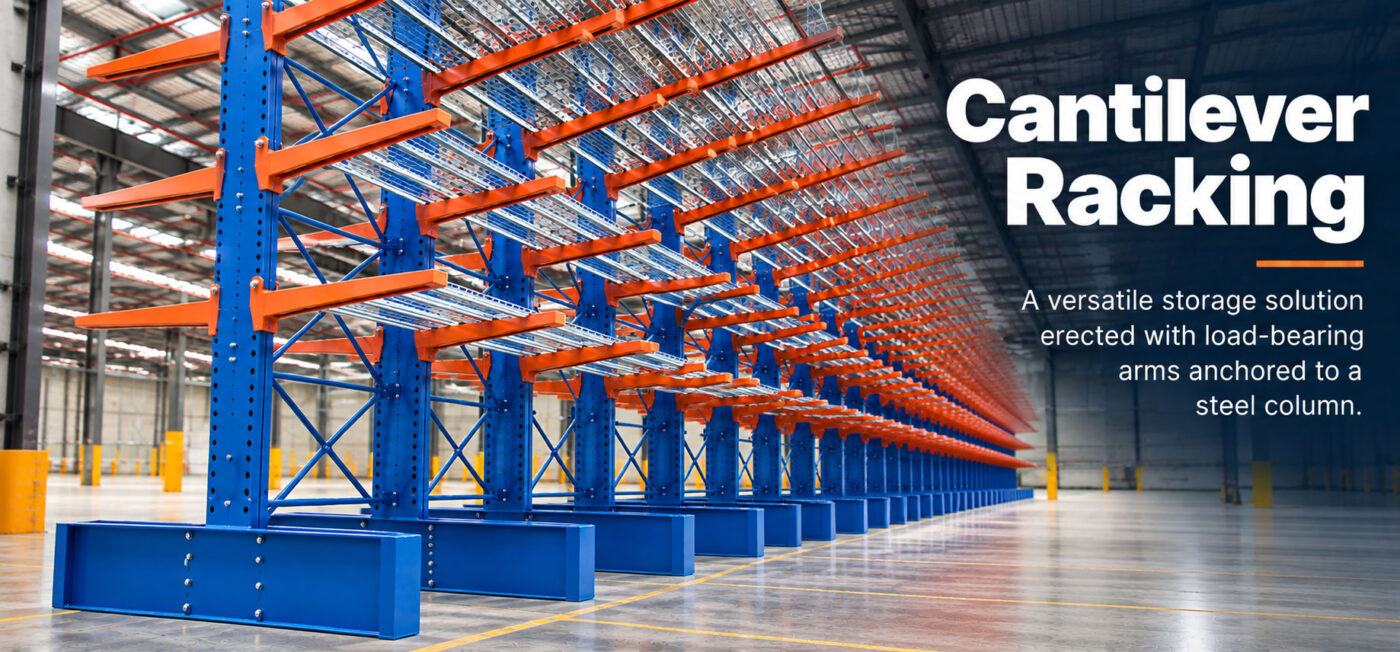
Cantilever racking is a heavy-duty storage system that uses horizontal load-bearing arms attached to vertical steel columns. Unlike conventional pallet racking, there are no front columns obstructing access to the storage area.
That open-front design is what makes cantilever racking particularly effective for materials that are too long, wide or awkward for conventional pallet racks.
Typical products stored on cantilever racks include:
- Lumber and timber
- Pipe and tubing
- Steel and aluminum sections
- Bar stock
- Sheet materials and panels
- Building materials
- Furniture and large components
- Extrusions and manufactured products
- Other long or irregularly shaped inventory
Instead of trying to make oversized products fit a storage system designed primarily around pallets, cantilever racking is designed around the product itself.
How Does Cantilever Racking Work?
A typical cantilever rack consists of a strong vertical column supported by a base, with horizontal arms extending outward to carry the load. Bracing connects the columns and provides stability.
The absence of front uprights gives forklifts and other material-handling equipment clear access to the stored material.
Systems can also be configured for different warehouse layouts. Single-sided cantilever racks can be positioned along walls or around the perimeter of a storage area, while double-sided systems provide storage on both sides of the rack and can make excellent use of open warehouse floor space.
Arm positions and rack configurations can be selected to accommodate different material dimensions, weights and storage requirements.
Better Use of Valuable Warehouse Space
One of the greatest advantages of cantilever racking is its ability to move inventory off the floor and take advantage of vertical storage space.
Long materials are often difficult to organize. When stored on the floor, they can consume substantial amounts of warehouse space while making individual products harder to access.
A properly designed cantilever system creates multiple storage levels, allowing different products, sizes or inventory groups to be stored vertically within the same footprint.
The result can be a cleaner warehouse and considerably better utilization of the building’s available cubic space.
Faster Access to Inventory
Storage capacity is only part of an efficient warehouse. Employees also need to be able to find, retrieve and replace products quickly.
Cantilever racking provides open access to stored materials without the front uprights found on conventional pallet racks. This can make it much easier for forklift operators to position long loads during picking and put-away.
Better accessibility can help reduce unnecessary product movement. Instead of moving one stack to reach another, materials can be organized on dedicated rack levels and accessed directly.
For busy warehouse and distribution operations, reducing unnecessary handling can translate into a smoother workflow.
Designed for Long and Awkward Loads
Trying to adapt conventional shelving or pallet racks to very long products can create inefficient storage arrangements.
Cantilever racking is purpose-built for this challenge.
Rack columns, bases and arms can be configured around the dimensions and weights of the products being stored. This makes cantilever systems suitable for applications ranging from relatively lightweight materials to demanding industrial storage environments.
For businesses whose inventory changes over time, a properly designed system can also provide valuable flexibility.
Better Organization and Inventory Management
A well-designed warehouse should make it easy to understand what is in stock and where it is located.
Cantilever racking allows long materials to be separated by product type, dimension, length or other inventory classifications. Instead of maintaining piles of similar-looking materials at floor level, products can be assigned to specific rack positions.
This can help employees identify inventory more quickly, simplify stock counts and improve overall warehouse organization.
Better organization can also reduce unnecessary handling and help protect inventory from damage caused by repeated moving, stacking and restacking.
A Solution That Can Extend Beyond the Warehouse
Cantilever systems aren’t limited to conventional indoor warehouse applications.
West Coast Installations has also used cantilever racking as part of more specialized storage projects. One recent project incorporated decked cantilever racking with custom roof trusses to create a covered drive-through storage building, with galvanized components selected to withstand West Coast weather.
This illustrates an important advantage of cantilever systems: they can form part of a much larger material-storage solution rather than simply functioning as another row of warehouse racks.
The Right Racking Starts With the Right Design
Cantilever racking isn’t a one-size-fits-all product.
The appropriate system depends on factors including the materials being stored, load weights, product lengths, building dimensions, available vertical space, aisle requirements and the material-handling equipment being used.
That’s why planning and engineering are important parts of a successful installation.
At West Coast Installations, we look beyond the rack itself. We provide comprehensive material-management solutions including layout and design, engineering and permits, installation, inspections, repairs, retrofits, rack replacement and ongoing support.
Whether you’re planning a new warehouse, expanding an existing operation or trying to make better use of your current storage space, the goal is the same: create a system that works with your operation rather than forcing your operation to work around the storage system.
Is Cantilever Racking Right for Your Warehouse?
If your operation regularly handles long, bulky or irregularly shaped materials, cantilever racking is worth considering.
The right system can help you:
- Use vertical warehouse space more effectively
- Free valuable floor space
- Improve access to long and oversized inventory
- Organize materials more effectively
- Simplify forklift loading and retrieval
- Reduce unnecessary material handling
- Protect inventory from damage
- Create a cleaner, more efficient warehouse
- Adapt storage around the products your business actually handles
The real opportunity isn’t simply to store more. It’s to create a warehouse where products move more efficiently from receiving, to storage, to picking and ultimately out the door.
Build a Better Warehouse with West Coast Installations
Every warehouse has different products, workflows and space limitations. The best storage solution starts with understanding those requirements.
West Coast Installations can help with the entire process – from warehouse layout and racking selection through engineering, installation and ongoing support.
If long, bulky or difficult-to-store inventory is consuming valuable warehouse space, talk to our team about a cantilever racking system designed around your operation.
Make better use of your space. Improve access to your inventory. Build a warehouse that works harder for your business.
